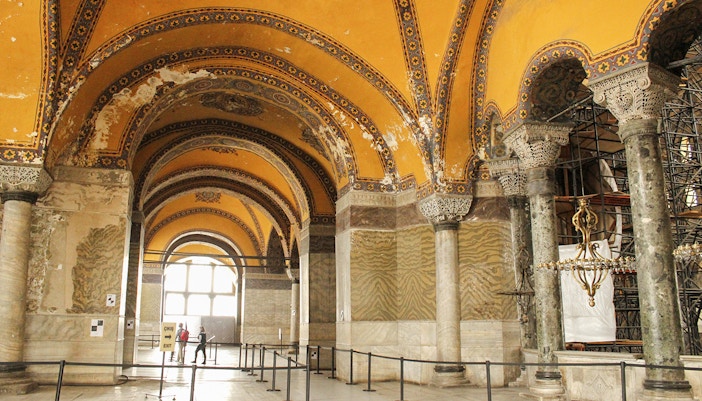
- Hagia Sophia was originally known as Magna Ecclesia, meaning Great Church, because of its large dimensions.
- The monument is over 14 centuries old, first consecrated in 360 C.E. by Bishop Eudoxius of Antioch.
- The building was constructed using green marble from Egypt, yellow stone from Syria, and black stone from the Bosporus.
- It was destroyed twice during construction: first during the 404 C.E. riots, then during the Nika Uprising in 532 C.E.
- The columns of the monument were repurposed from the Temple of Artemis to adorn and enhance the interior.
- It took approximately 10,000 workers to complete Hagia Sophia’s dome!
Hagia Sophia Church: Transformation from Church to Museum to Mosque
Few buildings tell the story of a city as powerfully as Hagia Sophia in Istanbul. Standing at the heart of the city as a living monument to 1,500 years of history, Hagia Sophia began as a church of the Eastern Roman Empire and later became a mosque, a museum, and now a mosque once again. Having witnessed conquests and cultural shifts reflected in its architecture and grandeur, this UNESCO-listed landmark continues to attract travellers from around the world.
Unique facts about Hagia Sophia Church

A close look at Hagia Sophia church
Origins
The original church at the site was built beside the Great Palace of Constantinople. The Hagia Eirene Church served as the main cathedral while the Great Church was still under construction. The majority of the current structure was built under Emperor Justinian I after the church was destroyed in 532 C.E.
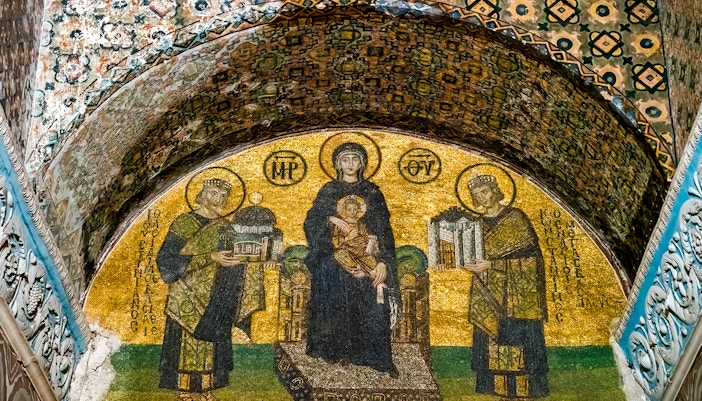
As a church
During Latin rule in the 13th century, Hagia Sophia became a Roman Catholic cathedral. After suffering damages from earthquakes, it was closed for repairs in 1354. Locals believed it was haunted and reported seeing the Holy Spirit leaving Hagia Sophia before Constantinople fell to the Ottoman siege in 1453!

As a mosque
Hagia Sophia was converted into a mosque immediately after the Ottoman conquest in 1453 by Sultan Mehmed II. Minarets were added, Islamic calligraphy was introduced, and the structure served as an important mosque for nearly five centuries.
As a museum
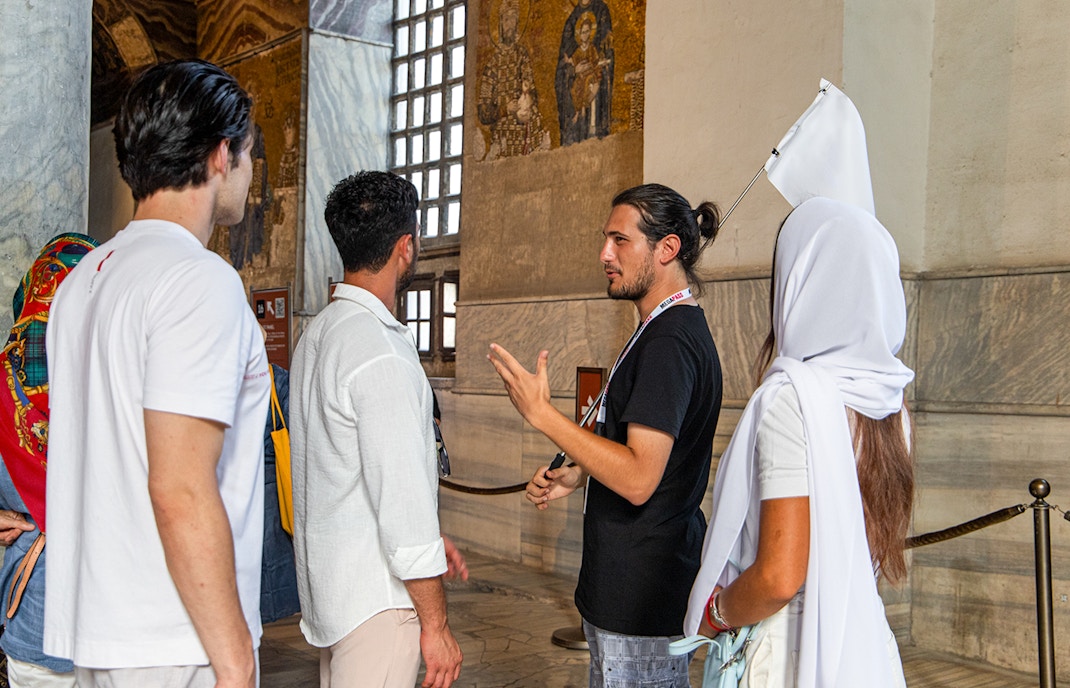
In 1935, the Republic of Turkey converted Hagia Sophia into a museum under Mustafa Kemal Atatürk. This period allowed the public to view both its Christian and Islamic elements and became a symbol of secularism and cultural preservation.

Current status
Since 2020, Hagia Sophia has been reconverted into an active mosque. Despite its religious function, it remains one of the most visited and iconic landmarks in the world.
Architecture of Hagia Sophia Church

Origins
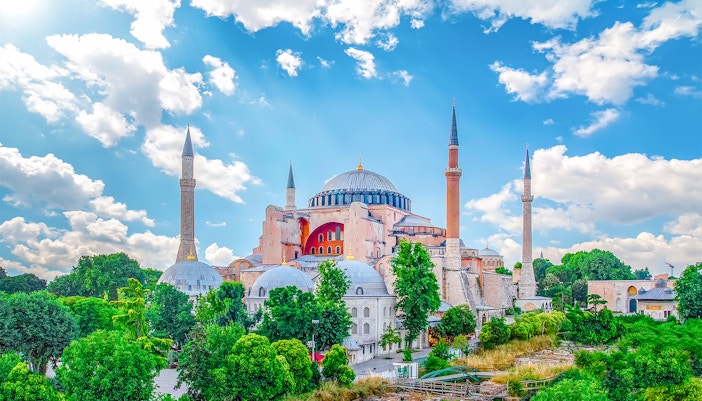
After the earlier church was destroyed, Emperor Justinian I commissioned the new Hagia Sophia in 532 AD, entrusting architects Isidore of Miletus and Anthemius of Tralles with its design. Their vision replaced the old basilicas with a vast central dome spanning roughly 31 meters and rising 55.6 meters above the floor.
Beyond the dome, Hagia Sophia’s layout is monumental. Marble columns, many repurposed from older monuments, support arches and vaults that complement the dome, creating a harmonious blend of verticality and horizontal space.

Renovation and structural evolution
Hagia Sophia’s scale and innovative design made it vulnerable to earthquakes and the effects of time. Over the centuries, the building faced further damage and underwent repeated repairs. Its interior also gained layers of artistic heritage: Byzantine mosaics depict Christ, the Virgin Mary, and saints, while Ottoman additions brought Islamic calligraphy, minarets, and mihrabs.
Hidden art and symbolism inside Hagia Sophia Church
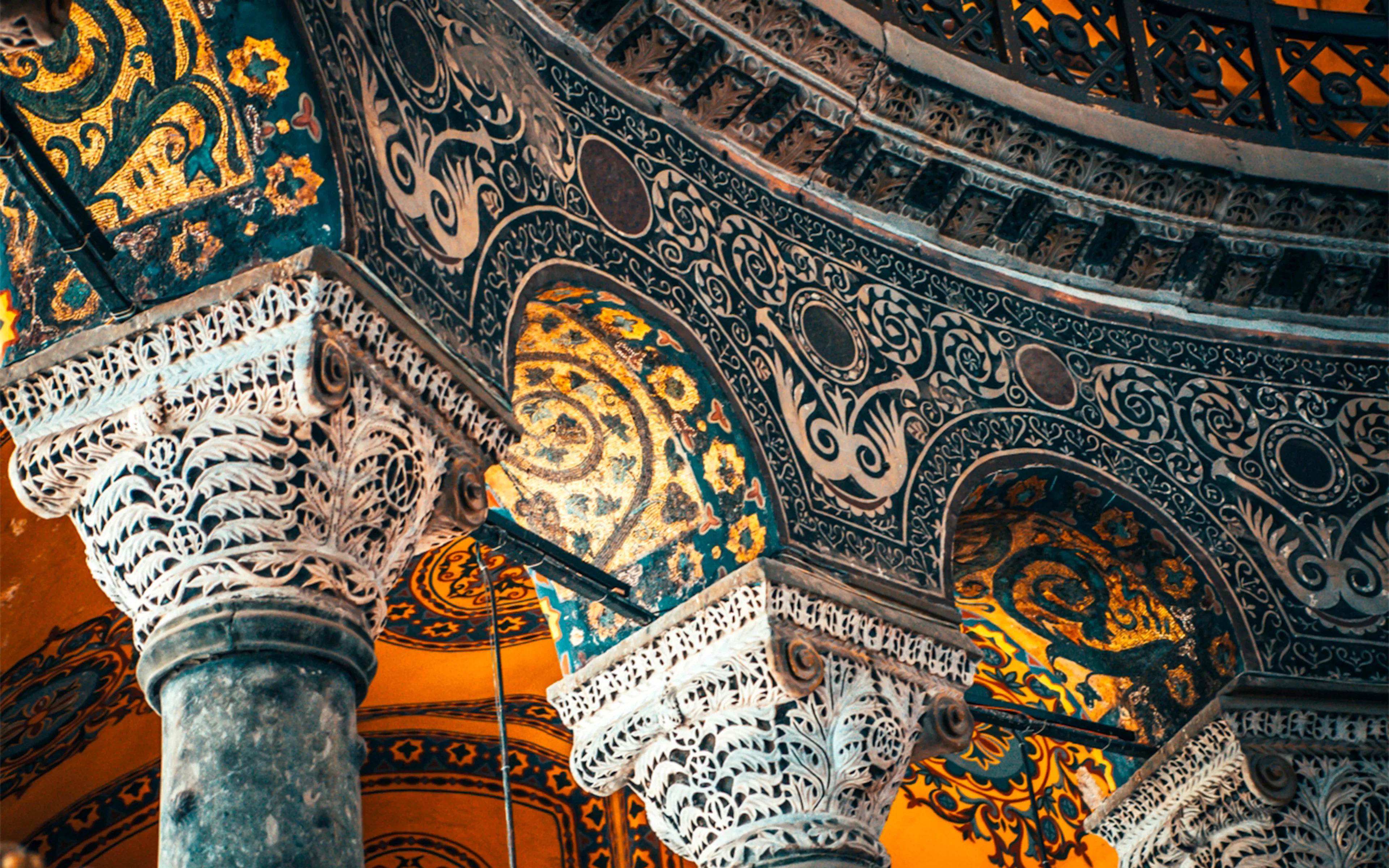
1/9
Mosaics and marble columns
Many columns come from ancient monuments across the former Roman and Byzantine world, adding to the building’s rich, imperial ambience.
Dome and window light effects
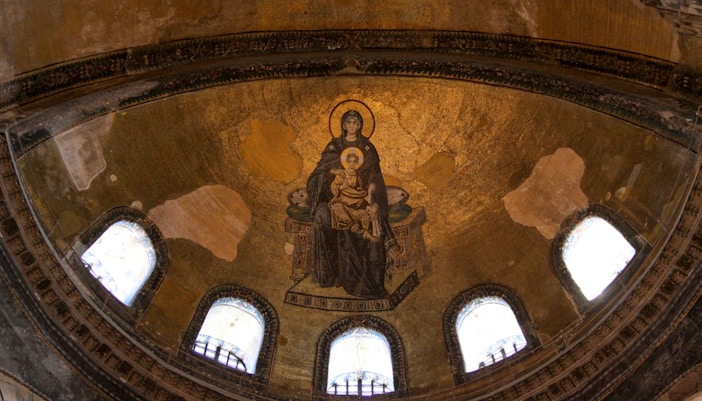
The base of the main dome and upper walls feature windows that filter sunlight across gold mosaics and marble surfaces, creating a spiritual and almost otherworldly atmosphere.
Deesis mosaic
Located in the upper gallery, it shows Christ flanked by the Virgin Mary and John the Baptist.
Imperial gate mosaic
Over the emperor’s entrance, this mosaic depicts a Byzantine ruler bowing before Christ, symbolizing divine authority and imperial power.
Apse mosaic of the Virgin Mary and Child
Positioned above the altar, the gold background highlights sanctity and the central role of Mary in Orthodox worship.
Seraphim mosaics
Six-winged angels are depicted on the pendentives that support the dome, representing the heavenly realm and enhancing the building’s sacred vertical axis.
Wishing Column (Weeping Column)
A marble pillar believed to bring good fortune when touched or rotated.
Ottoman additions
Minarets, a mihrab, a minbar, and large Islamic calligraphy panels were added, blending Islamic elements with the existing Byzantine architecture.
Large calligraphic medallions
Circular disks bearing Arabic inscriptions of Allah, Muhammad, and early caliphs, added during 19th-century restoration, reflect its Islamic era identity.
Frequently asked questions about Hagia Sophia Church
The Hagia Sophia Mosque was originally built to function as the primary Christian Orthodox church in Constantinople in 537 AD. It is a treasure trove of Byzantine art and architecture.
The Hagia Sophia is open daily throughout the year. It is closed to non-worshippers only during prayer times.
The present-day Hagia Sophia was originally built as a Christian cathedral in the 6th century during the Byzantine Empire under the orders of Emperor Justinian I. It was completed in 537 AD. It was constructed to serve as the main church of Istanbul and to symbolize the grandeur and power of the Byzantine Empire.
Yes, you can purchase Hagia Sophia skip-the-line tickets and guided tours online. It is best to purchase these tickets online because it is more convenient and you can pre-book tickets in advance to avoid standing in long lines on the day of your visit.
Since the Hagia Sophia Mosque is an active place of worship, we recommend you avoid clothes that show your shoulders or knees. You have to wear a headscarf to enter the mosque. You can find scarves at the entrance.
You can either get on the M2 metro or the T1 tram and reach Sultanahmet Square, a short walk away from the Hagia Sophia. The Marmaray (Atakoy to Pendik) or Marmaray (Halkali to Gebze) trains also stop at Sultanahmet Square. Bus numbers 28, 32, BN1, and EM1 also pass by Sultanahmet Square. You can hop on any of these buses to reach the Hagia Sophia.
Inside the Hagia Sophia, you can witness a fascinating blend of Christian and Islamic art. The vast interiors are dominated by a massive Central Dome, which is supported by four large arches and a ring of smaller domes. Some of the frescoes and mosaics on the walls date back to the Byzantine era when Hagia Sophia was a Church. The walls also contain Islamic inscriptions and words from Allah and Prophet Mohammad.
If you are around Sultanahmet Square or are visiting the Blue Mosque or the Istanbul Grand Bazaar, you can walk to the Hagia Sophia.
More Reads
Plan Your Visit
Hagia Sophia Architecture